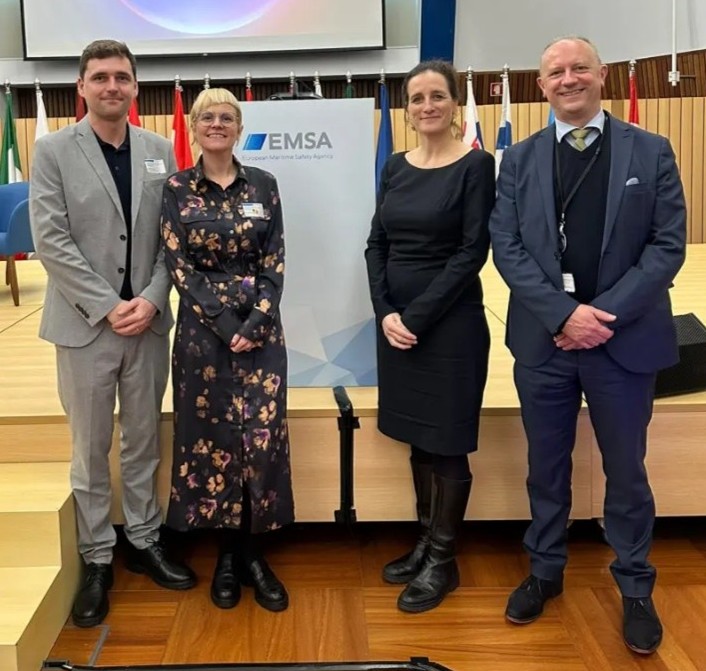
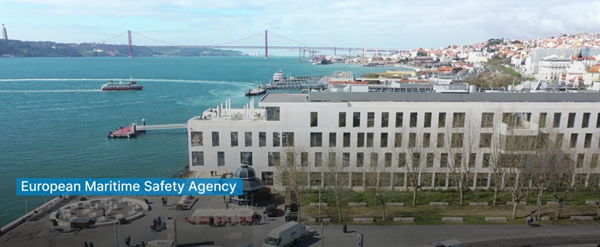
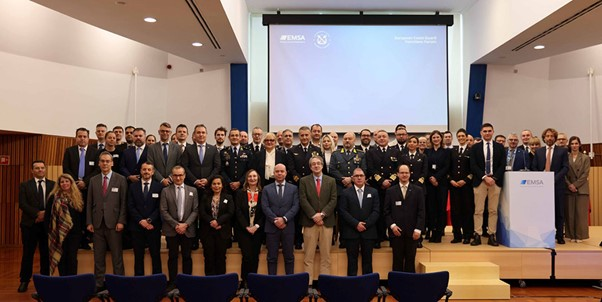
On 11-12 February 2026, the European Maritime Safety Agency (EMSA) hosted the first thematic workshop of the European Coast Guard Functions Forum (ECGFF) programme for 2026 at its premises in Lisbon. Belgium took part with representatives from DG Shipping (Stefanie Monsaert), agency for Maritime and Coastal services (Yves Maekelberg), the Coast Guard (Eefje Deweer) and the Scientific Service ‘Management Unit of the Mathematical Model of the North Sea’ of the Institute of Natural Sciences (Kobe Scheldeman).
Multifunctional and Complementary Surveillance
Modern and effective coast guard surveillance requires a multifunctional approach in which various assets — such as satellites, drones (both underwater and aerial), aircraft, vessels and ground systems — are deployed in a complementary manner. No single tool is sufficient on its own to address today’s complex maritime challenges.
Through cooperation between agencies and Member States, and by combining technologies, a robust, real-time maritime situational picture can be achieved. This enables the efficient coordination of safety, environmental protection, fisheries control and law enforcement tasks.
Geopolitical Developments and Operational Impact
Participants reflected on the rapidly evolving geopolitical context and its implications for daily maritime operations. A notable trend is the recent increase in falsely flagged vessels and the activities of the so-called shadow fleet: older, poorly maintained ships whose flag authenticity and insurance documentation are difficult to verify, posing an increased risk of incidents.
By pooling expertise, sharing operational information among Member States, and enriching it with additional data sources, steps are being taken to better identify and monitor these vessels. Many of them never enter ports and continue operating at sea through ship-to-ship transfers, with all associated risks. While the principle of freedom of navigation remains fundamental, it also complicates enforcement efforts.
EU Agencies Strengthen Their Support
EMSA provided an update on its services, with particular attention to the further development of its Remotely Operated Vehicle (ROV) capacity. These systems can operate at depths of up to 3,000 metres and are deployed for investigations and operations such as mapping cables, anchors and wrecks. Belgium has already made use of these services over the past two years.
The European Fisheries Control Agency (EFCA) presented a timeline for new regulations and technological tools, including hydrophones (to detect illegal fishing through sound monitoring), DNA kits (for fish species identification), satellite imagery, Remote Electronic Monitoring (REM), drones (UAVs) and artificial intelligence. Although these technologies were not originally developed specifically for fisheries control, the necessary adaptations are now being implemented to optimise their use in this field.
Frontex outlined the possibilities of deploying its aircraft for various coast guard functions. These aircraft provide maritime situational awareness, can zoom in on suspicious vessels and transmit imagery to onshore operation centres in near real time. In the event of incidents, flight plans can be rapidly adjusted.
The Need for a New Belgian Coast Guard Aircraft
The findings of the workshop highlight a clear reality: maritime surveillance is becoming more technologically complex, geopolitically sensitive and operationally demanding. In this context, air capability is not a luxury but an essential component of the integrated European surveillance system in which EMSA and Frontex operate.
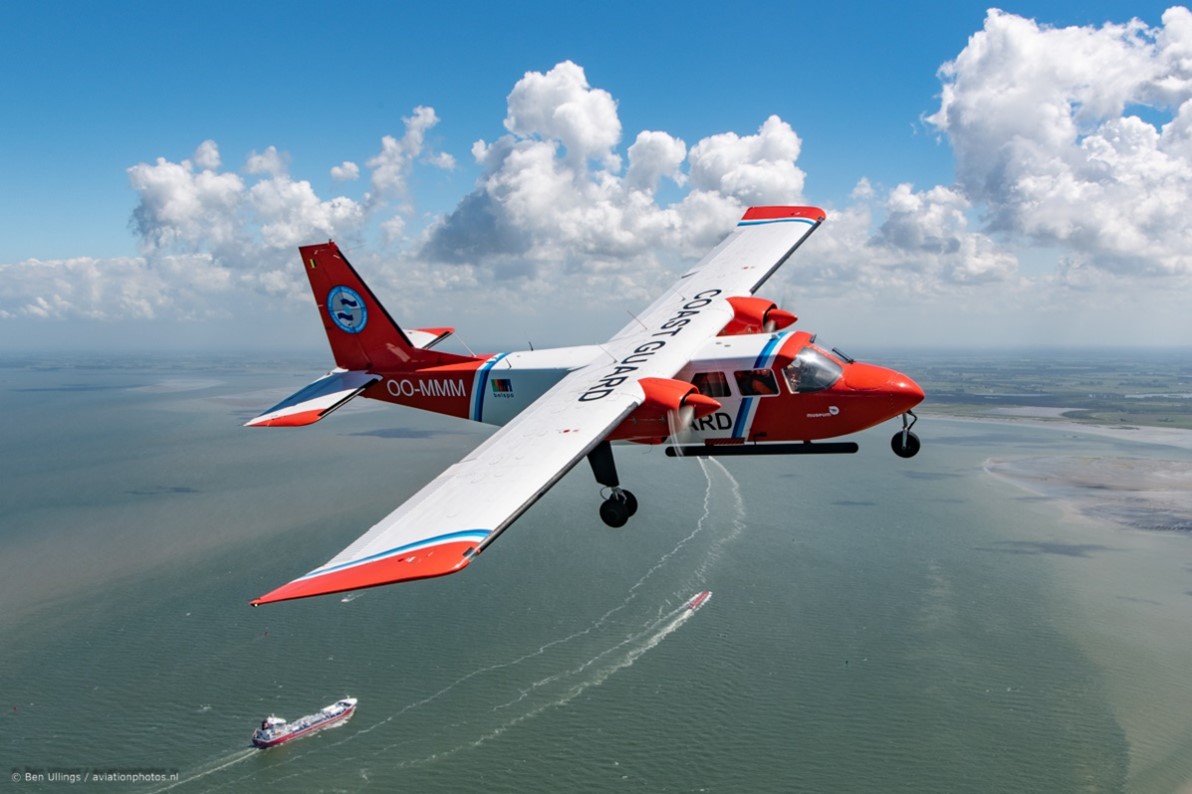
After more than 30 years of successful aerial surveillance, it must be acknowledged that the Belgian coast guard aircraft is an ageing platform that will turn 50 this year. While the aircraft has long been a reliable asset in environmental protection, safety and maritime law enforcement, it is no longer sufficient to carry out the increasingly delicate and technologically intensive operations expected from a coastal state today.
The rise of shadow fleets, GPS spoofing, complex energy transport operations and stricter European obligations require modern sensors, real-time data processing and interoperability with European partners. Replacing the current aircraft is therefore essential to guarantee the continuity of these missions.
Without a new coast guard aircraft, Belgium risks no longer having an adequate aerial surveillance platform at its disposal. This would seriously undermine our ability to meet national and international obligations in the fields of environmental protection, crisis response, safety and security in the North Sea.
Within the Coast Guard, under the coordination of Defence and the Institute of Natural Sciences, intensive work is therefore underway with all relevant partners to prepare and implement the replacement of the aircraft, ensuring that Belgium will continue to possess a modern, high-performance and interoperable aerial surveillance capability in the future.